

octobre 2026
Christian Noorbergen
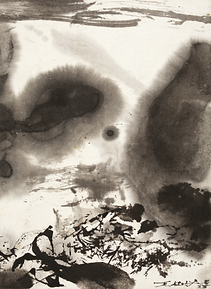
Zao Wou-Ki, Sans titre, 1975 — Encre sur papier — 18,3 x 13,2 cm© Bertrand Michau

La confusion est complète 1958 - encre de chine sur papier, 56 x 76 cm. © Bertrand Michau
Before becoming the current Galerie Berthet-Aittouarès, the former Galerie Pierre hosted Henri Michaux in 1938, followed by Zao Wou-Ki in 1951. In 1926, at that same gallery, Michaux attended an exhibition of Paul Klee’s work; he emerged overwhelmed by a profound silence and was reconciled with painting! Together with her daughter Odile, Michèle Aittouarès, to mark the 40th anniversary of their gallery, has brought together these two artists—the Belgian from Namur (1899–1984) and the Chinese artist from Beijing (1920–2013)—“whose works and personalities have left a lasting impression on me.” The current exhibition, organized in collaboration with the Zao Wou-Ki Foundation and the Henri Michaux Archives, consists primarily of Chinese ink drawings and watercolors. It is structured around a dialogue between these two great artists, who were longtime friends; Michaux invited Pierre Loeb to discover the young Chinese artist’s first lithographs in 1947.
A beautiful catalog is in the works, featuring contributions by François Michaud—who organized a major Zao Wou-Ki retrospective at the Museum of Modern Art in 2018 and 2019—and Catherine Zittoun, who wrote *Zao Wou-Ki, Henri Michaux: A Friendship* in 2018. An avid traveler, Michaux explored the length and breadth of China. Fascinated by ideograms, he wrote on this subject just as he would later write about his Chinese friend’s lithographs. It was Michaux who convinced Zao—devastated by the Cultural Revolution—to return to Chinese ink painting… The breathing void of ancient Asian art captivated Michaux, the painter-poet translated all over the world. His drawings and watercolors explore language through a dazzling dance of signs—spontaneous strokes born of conscious and unconscious movements—in a true form of gestural calligraphy, a pure mental seismogram. Signs, stains, and scripts invent unknown, vibrating appearances that remain perpetually weightless.
The space encompasses a multitude of forms, beings, and virtual states. It is up to him, humble and secretive, to dare to reveal them: “Like me, the line searches without knowing what it seeks, rejecting immediate discoveries, the solutions that present themselves, the first temptations...” Works created quickly, with a fan to speed up drying time, but sometimes just as quickly torn apart...
Zao Wou-Ki, who dislikes titles, practices an art that fuses the stain and immensity, while light and darkness intertwine in the depths. More than abstract landscapes, Zao paints a timeless nature, distant and detached—an archaic nature in which the dimension of the sky is always dominant. A friend of Michaux, then, but also of Edgar Varèse, poetry and music remain for him two permanent poles of attraction, like two foundations of his painting. Each work is a fabulous slice of the universe—airy and invigorating, never geometric, and always in motion.